At Sartarelli, they only drink Verdicchio (dei Castelli di Jesi). A precise choice, demonstrating a strong, uncompromising attachment to the grape variety, the wine, and the territory.
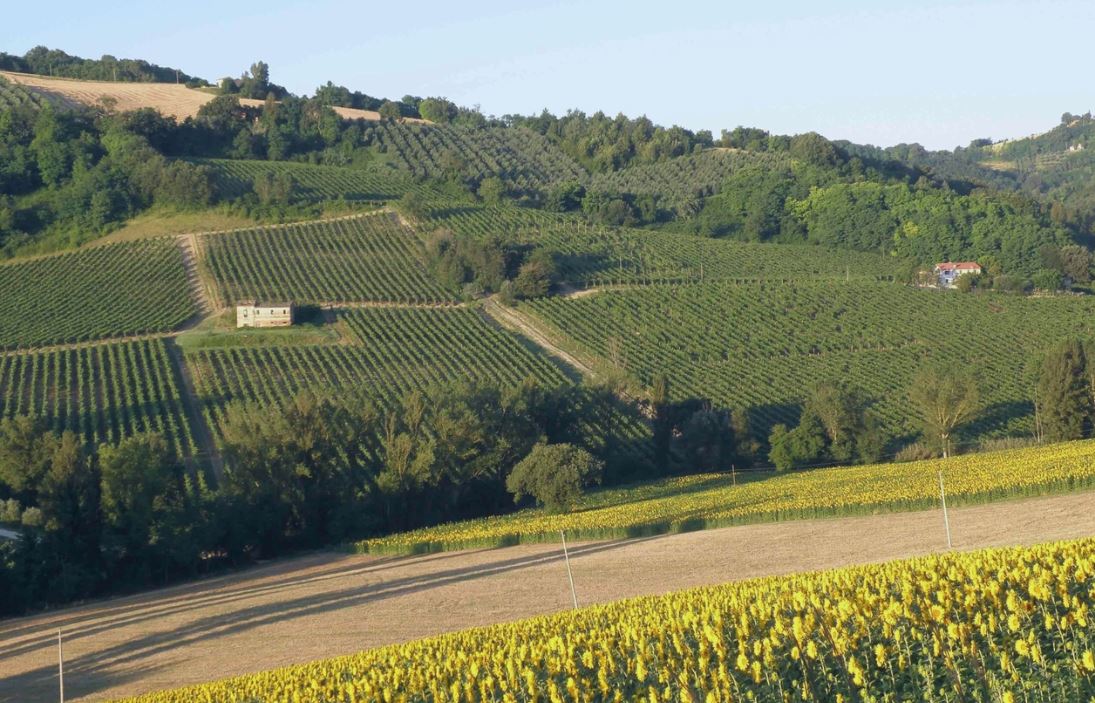
In one of our first autumn stop-and-gos, we meet Patrizio, who guides the winery along with his wife Donatella and children Caterina (Export Manager) and Tommaso (Oenologist), right in the vineyard. We are in a six-hectare vineyard that has just been harvested (“there are more grapes than last year; the warm, breezy climate helped us keep the bunches dry and healthy”). Caterina, who splits her time between Dutch, German, and English clients, introduces us to Verdicchio on a panoramic educational terrace, where the horizon stretches to the Adriatic Sea and Mount Conero, all while maintaining visual contact with the raw material: the grapes. This is a way, without much fuss, to make you understand that there is wine and wine, Verdicchio and Verdicchio, just as there are many ways of conceiving one’s work.
Their wines are particular selections from the same vineyard or different vineyards. There is great care at the foundation. “Where we are now, we planted thirty-two different Verdicchio clones to give the wine more complexity. In the vineyard where we produce our Riserva, we noticed that one particular barrel of Verdicchio always stood out, so we saved those clones and used them for the blend, which the regulations allow up to 15% with grapes or wine of other types, such as Trebbiano and Malvasia. Here, it is 100% Verdicchio in the glass. My father-in-law, Ferruccio, always believed in this grape variety. He bought the farmhouse with the surrounding land in 1972, then about thirteen hectares, including a historic 52-year-old vineyard that we have preserved.”
Sartarelli, which cultivates 36 hectares of its own land out of the approximately 2200 total hectares in the entire denomination, produces Verdicchio only in purity and without the “sophistications” of wood aging (“we use steel and cement because the barrique always imparts that hint of vanilla, and instead, we want the territory to shine through”).
The range includes various types, accompanying the entire meal, from aperitif to dessert. It starts with the Brut sparkling wine—an excellent, highly drinkable long Charmat, perfect for a non-conformist aperitif—and ends with the Passito (from grapes laid out on racks to dry for about a month). In between are the Classico, the Tralivio Classico Superiore (from a selection from older vineyards, where green harvesting is performed to reduce production to 80 quintals per hectare), the Riserva Milletta (from a single vineyard, with cryomaceration for at least 24 hours and almost two years of aging between steel and bottle), and the multi-award-winning Balciana (from late-harvest grapes selected only in the best vintages, from a single vineyard in the Balciana district). The Balciana—intense, complex, a kaleidoscope of never aggressive aromas and flavors—is a reverse selection because the best grapes are left on the vine and harvested in late November. And, of course, there is grappa, obviously made from Verdicchio. The wines are long-lived thanks to their alcohol content, body, and because they do not undergo malolactic fermentation (“two or three grams of malic acid support us in longevity and freshness”).
In the vineyard, the commitment for more than ten years to farming with detoxification efforts results in certified products without chemical residues, thanks to an integrated pest management strategy based on technology and natural products used for all the vineyards. “In the first vegetative phase, before flowering, we resort to pesticides. With the formation of the berries, we only use resistance inducers—meaning technological products and natural extracts derived from herbs, algae, and yeasts that, when sprayed on the plant, simulate disease attack, stimulating the plant’s reaction capacity,” Patrizio continues. The installed solar system covers the energy needs “except during the harvest period,” he specifies.
We are in the Marche region, in the Ancona area, in the territory of the Castles of Jesi, the cradle of Verdicchio, on the left bank of the Esino River. Specifically in Poggio San Marcello (just over three hundred meters above sea level), one of the eighteen municipalities in the historic heart of the denomination, the noble, classic zone. Gentle hills sloping towards the sea, on whose summits peek medieval villages encircled by walls, rich in culture and museums, perched around the city of Jesi, the birthplace of Emperor Frederick II of Swabia and the musician Giambattista Pergolesi, and which preserves the most beautiful paintings by Lorenzo Lotto, previously scattered in churches. A territory caressed by a light and constant breeze, among vines and olive trees (about 2300 plants owned by the family, mainly Frantoio and Leccino varieties) that is waiting to be discovered, photographed, and “Instagrammed” in its most iconic locations. The winery is located a handful of kilometers from the Gola della Rossa and Frasassi Regional Natural Park (with the famous underground karst caves), a protected natural area extending across the Apennine side of the province.
The Verdicchio museum inside the estate was established seven years ago and “tells us” that ethyl caffeate, one of the main natural phenolic antioxidants, is present in high concentration in this grape.
Welcoming the visitor are the paintings of Louis Jaquet, a contemporary French-American painter who “fell in love” with Verdicchio several years ago. “He lives in San Casciano Val di Pesa, in the Bargino area, next to Antinori. He arrived here by chance about thirty years ago, entered with a small demijohn, and asked me to fill it in exchange for a watercolor. He was living in the Marche region at the time. When we built the new structure, I asked him for an oil painting of how he remembered the winery.”
Also interesting is the representation of the so-called Mystic Press (Torchio Mistico), where Christ is depicted with vines and grapes that, crushed by himself, become blood collected in chalices, symbolizing the gift of life.
How many experiences one can have in front of a glass of wine!