Castle and surrounding walls
Details
The Castle of Poggio San Marcello, located in the heart of the namesake Marche village, is a fascinating testimony to the region’s medieval history. Built in the 13th century, the castle stands on a hill 387 meters above sea level, offering a panoramic view of the surrounding valley.
Of the Medieval Castle from the beginning of the 16th century, what remains is the remarkable curtain wall which appears almost continuous and embraces the houses clustered inside, within an oval circuit of 150mx100m, with the two gates representing the poles. Six bastions of different shapes reinforce the defensive system. The bastion flanking the western gate has a pentagonal plan with an overhang of raised corbels (beccatelli); the other near the opposite gate is quadrangular, sloped, and elevated with a shrine (edicola) in the center and surmounted by a frame of brackets (mensole); the next one to the north is an irregular hexagonal shape, massive and severe, without corbels; this is followed by a raised tower (torrione) and finally, a small truncated pentagonal tower. The wide-arched entrance gate is surmounted by corbels, while the one on the opposite side is inscribed within an arch supported by pillars. The bastions were rebuilt by Domenico di Giovanni da Bellinzona in 1503.
Today, the curtain wall of Poggio S. Marcello divides the part of the Historic Center enclosed within the Castle from the surrounding hamlets (borghi). During the dark three-year period of 1452–1455, during which Turkish raids occurred, Poggio San Marcello was counted among the settlements (Borgate) that were indefensible in case of siege because it was an “open Castle” (unwalled). After the earthquake of 1502–1503, Poggio San Marcello built its castle walls, and its population gradually moved from the hill (Poggio) into the castle walls.
Gallery


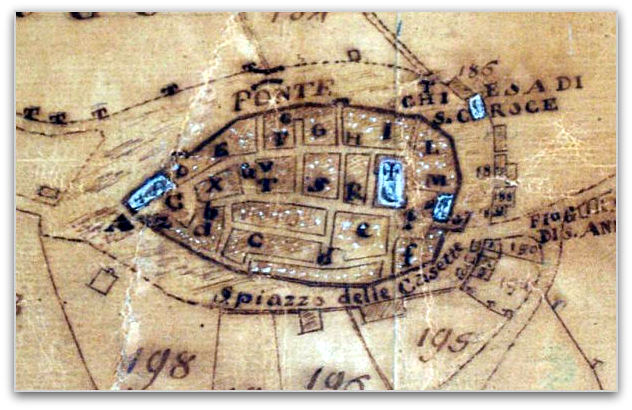
Map of the Castle, detail from the 1769 cadastral map (Historical Archive of Poggio San Marcello, Mayor's Room).
The layout of the Castle is virtually identical to that of the 17th century. Behind the northern walls, one can see the bridge that crossed the fosso della Cupa, from which the community drew water for the public fountain. On the opposite side, near the south-eastern walls, is the Spiazzo (open space), where the small houses and gardens of the village were located, which began to form around the castle as early as the 17th century.
(Photo by C. Bellini)
Source: "The Community of Poggio San Marcello in the 17th Century" - Master's Thesis by Romina Mancini