Church of Santa Croce and Fornace
Details
In Poggio San Marcello, there is a beautiful small temple (tempietto) of perfect 18th-century style, datable between 1738 and 1740, which still exists as the Oratory of Santa Croce (Holy Cross) and is attributable to the well-known local architect of the time, Mattia Copponi (perhaps the first work done by the architect himself, who was only eighteen years old at the time). This Oratory was built near the preceding 17th-century funerary hall, the remains of which can still be seen behind the oratory itself, and was reserved for the Confraternity of the Buona Morte (Good Death).
Since, in addition to the Oratory of Santa Croce, the Church of San Nicolò da Bari and the Town Hall (Comune) were also built in Poggio between 1738 and 1775, it is therefore assumed that only by sourcing the large quantity of clay bricks from a local production could the enormous expenditure that the three aforementioned masonry works imposed on the population be met. If tradition does not mislead, Mattia Copponi would have made use of bricks coming from the kiln (or furnace) of Poggio San Marcello.
We have two indirect pieces of evidence: the name of a kiln worker (fornaciajo) who owned the kiln in the 18th century, certainly Luca Bozzi, and the date “A. 1786” affixed beneath some terracotta amorini (cherubs/putti) located outside the “Casa Felicetti.” Therefore, the Kiln of Poggio San Marcello began its production of bricks right in the years 1738–1740, and the kiln itself seems to be the main point of assurance and encouragement for the large-scale construction in the town.
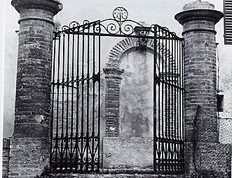
Evidence of what has been stated is also provided by the beautiful 18th-century pillars placed at the entrance to the small courtyard of Marconi-Sansoni house, where the production of shaped brickwork (laterizi limati) and the “cantari” (ornamental elements, possibly vases or capitals) superimposed on the pillar evoke the amorini, the small lions (leoncelli), and the small corbels (mensoline), giving rise to a genuine workshop of handcrafted terracotta products, which utilized the clay excavated in the surroundings of Poggio.